Friday, October 6, 2017

NICO FIDENCO

Looking back at the chart action of Italian acts in Brazil during the so-called 'Italian invasion' (1963-1967) one can clearly see that Rita Pavone was the #1 act followed by Sergio Endrigo, Bobby Solo. Pino Donaggio and Nico Fidenco.

Nico Fidenco was actually the first act to break through the Brazilian charts with 'Legata a un granello di sabbia' in 1963.

Fidenco's first 2 albums sold a lot of copies and he had quite a few hits with 'Tutta la gente' (1963), 'Se mi perderai' (1964), 'Con te sulla spiaggia' (1964) and finally 'A casa d'Irene' in 1965.
by May 1965, the Italian wave was abating but Nico Fidenco went up the charts with 'A casa d'Irene' which tells the story of a mysterious brothel in a world resembling 'Blade runner'...

Nico Fidenco née Domenico Collarossi on 24 January 1933, in Rome. He made the grade circa 1961, when 'Legata a un granello di sabbia' went to #1 in Italy and crossed over to the European continent as well as Latin America. 


1960 - What a Sky / Su nel cielo (RCA Serie Europa – PM45 1109)
1961 - Non è vero / Una voce d'angelo (RCA Serie Europa – PM45 1127)
1961 - Il mondo di Suzie Wong / Tornerai... Suzie (RCA Serie Europa – PM45 1144)
1961 - Legata a un granello di sabbia / Ridi, ridi (RCA Serie Europa – PM45 1166)
1962 - Tutta la gente / Lejos me voy (RCA Serie Europa – PM45 3133)
1963 - Una donna nel mondo / Perché non piango più (RCA Italiana – PM45 3167)
1963 - Tutta la gente / Mondo meraviglioso (RCA Serie Europa – PM45 3169)
1963 - Se mi perderai / Goccia di mare (RCA Italiana – PM45 3199)
1963 - Cleopatra / Non mi chiedi mai (RCA Italiana – PM45 3222)
1963 - Hud / Ciò che rimane alla fine di un amore (RCA Italiana – PM45 3224)
1964 - Con te sulla spiaggia / Mi devi credere (RCA Italiana – PM45 3255)
1964 - A casa d'Irene / Ma dai (RCA Italiana – PM45 3299)
1965 - L'uomo che non sapeva amare / Tu non sei l'altra (RCA Italiana – PM45 3311)

Nico Fidenco visits Brazil for the 2nd time; sings at Teatro Record from 12 to 16 May 1965.

Thursday, September 21, 2017

Rita Pavone's Brazilian 1st release: August 1963; Nico Fidenco & Tony Campello

As one can see by these ads at Radiolândia mid-1963... the trend was towards the ascendancy of the Modern Italian Music coming from the Peninsula... 
fortnightly 'Radiolandia' - 15 August 1963 - shows an ad of the release of  Rita Pavone's very first record in Brazil: an Extended Play containing 4 tracks: 'La partita di pallone', 'Come te non c'è nessuno', 'Alla mia età' & 'Clementine Chérie'; 

Radiolandia 15 September 1963 also brings an ad of Nico Fidenco's newest album called 'Canta Nico Fidenco' (BBL-149); That was Fidenco's 2nd album; his 1st LP 'Nico Fidenco' (BBL-124) had been released in May 1963 featuring 'Legata a un granello di sabbia' which went to the top of the charts.

At the same issue (15 Sept 1963) Radiolandia shows an ad of Tony Campello's newest album 'Não te esqueças de mim' (Non ti scordar di me) recorded originally by Frankie Avalon.   

1. 'Não te esqueças de mim' (Non ti scordar di me) Curtis-Richter-Furno; v.: Fred Jorge
2. 'Esta noite' (Tonight could be the night) Virgil Johnson from The Velvets; v.: Fred Jorge
3. 'Presa a um grãzinho de areia' (Legata a un granello di sabbia) Marchetti-Fidenco; v. Nazareno de Brito;  4. 'Moon River' (Henry Mancini-Johnny Mercer);
5. 'Quando, quando, quando' (Tony Renis-Testa; v.: Teixeira Filho)
6. 'Vamos fingir' (Making believe) Schwope; v.: Fred Jorge

1. 'Como sinfonia' (Come sinfonia) Pino Donaggio; v.: Romeu Nunes
2. 'Não toque esta canção' (Don't play that song, you lied) Ertegum-Nelson; v.: Hamilton di Giorgio; 3. 'Non esser timida' (Little lonely one) Del Prete;
4. 'Pingo d'água' (Raindrops) D.Clark; v.: Nick Savoia
5. 'Quem me faz sofrer' (Mattinata) Leon Cavallo; adapt.: Fred Jorge
6. 'O dia do amor' (Our day will come) Hilliard; v.: Fred Jorge.
 
Tony Campello's album 'Não te esqueças de mim', released mid-1963.

Wednesday, June 14, 2017

Roberto Carlos shows his preference for Gigliola

Sergio Endrigo & Roberto Carlos win big in San Remo 1968.
'Fatos & Fotos', 21st March 1968
weekly magazine 'Revista do Radio' asked a few show-business people in 1969 - what female singer they thought was the most charming of all. Roberto Carlos chose Gigliola Cinquetti. He must have met Gigliola at San Remo in 1968, when Carlos sang Sergio Endrigo's 'Canzone per te' and Cinquetti sang 'Sera'.
Rock star Roberto Carlos confesses he is charmed by Gigliola Cinquetti.
Gigliola Cinquetti & Roberto Carlos in Italy in 1968 (most likely). 
Roberto Carlos during his stay in Milan, July 1968.
R.C. and Sergio Endrigo in the summer of 1968.

Sunday, January 15, 2017

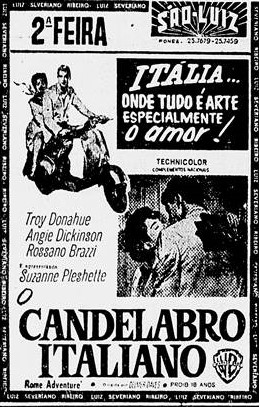
'O CANDELABRO ITALIANO' (Rome adventure) - 27 February 1963

24 February 1963 It was a Sunday before Carnaval; 'O candelabro italiano' (Rome Adventure) would open exactly on Ash Wednesday27 February 1963 at Cine Astor and Cine Paisandu. The columnist at newspaper 'O Estado de S.Paulo' wrote a lot of non-sense about the movie he had not seen yet even saying Suzanne was French when everyone knows Ms Pleshette was born in Brooklyn, New York, on 31st January 1937.

Nothing of that really matters. What really matters is that 'O candelabro italiano' despite having opened at Carnaval's low season went on to become one of the most popular movies shown in 1963... sending 'Al di là' sung in the sound-track by Emilio Pericoli to Number One in the Brazilian charts in such a fashion that it opened the flood-gates to the Italian pop music invasion of Brazil.
Historia de um quarteto amoroso que se complica e também encontra sua solução em meio as atrações turísticas de Roma. Como diretor, Delmer Daves não inspira nenhuma confiança, mas pelo produtor sabe como dar certa classe a seus filmes. Este marca a estreia de Suzanne Pleshette, uma francesinha parecida com Elizabeth Taylor, e que vem causando sensação nos Estados Unidos.

19 May 1963 - Correio da Manhã's columnis seems more up-to-date than his Paulista counterpart at Estadão's; he knows what the director Delmer Daves was all about and also knew Suzanne Pleshette was an American actress. Here's what Wikipedia wrote about the director: Delmer Daves (*24 July 24 1904 +17  August 1977) was an American screenwriter, director, producer, and actor. Daves wrote, produced and directed a series of films with Troy Donahue at Warners: 'A summer place' (1959) with Sandra Dee, 'Parrish' (1961) with Connie Stevens, 'Susan Slade' (1961) with Connie Stevens again and 'Rome Adventure' (1962) with Suzanne Pleshette and Angie Dickinson.

Following the success of 'A summer place', Daves's career made an unexpected and profound shift away from the masculine action films Daves had become known for towards so-called "women's pictures." According to Daves's son, Michael Daves, this change was precipitated partly by Daves's heart attack in 1958; on his doctors’ advice, he decided to limit himself to less strenuous, studio-based productions.

'Correio da Manhã' columnist goes beyond and says Hollywood 'went Italian' with Panamanian director José Quintero shooting 'The Roman spring of Mrs Stone' in the streets of Rome in 1961. Mrs Stone, an old American actress is played by Vivien Leigh and Warren Beatty plays a local Italian gigolo who seduces the middle-aged lady. 

Vincent Minelli also shot a movie in Rome 'round 1961; 'Two weeks in another town' also dealt with former Hollywood characters trying a new lease of life in Italy. The story was seen by some as a depiction of the relationships among Tyrone Power, Linda Christian and Darryl Zanuck. Kirk Douglas, Edward G. Robinson, Cyd Charisse,  George Hamilton and Rosanna Schiaffino play the main parts. 
15 May 1963 - Rio de Janeiro saw 'Rome adventure' (O candelabro italiano) 3 months after Sao Paulo... nonetheless when the Italian pop music invasion took place Rio was as much 'flooded' with Italian hits as Sao Paulo had been...
'Lovers must learn', a book by Irving Fineman, was published in 1932. Unlike the film, the novel was set in Paris. Delmer Daves purchased the rights to the novel in 1957 and announced plans to make a film version in France, Copenhagen and Switzerland.

Natalie Wood was at one stage announced for the lead. Troy Donahue was announced for the male lead relatively early. Eventually Natalie Wood dropped out and Suzanne Pleshette was signed in September 1961.

The film was known during production as 'Lovers must learn'. Donahue and Pleshette fell in love while filming.

The song "Al di là" featured in the film and performed by Emilio Pericoli was originally recorded by Betty Curtis and Luciano Tajoli and winner of the 1961 edition of the San Remo Festival, subsequently becoming Italy's entry to Eurovision 1961. Connie Francis recorded it too.
22 December 1963 - by the end of 1963 Alberto Lattuada's 1962 production 'Mafioso' which had Norma Benguel in the female-lead was released with pomp & circumstance... in the Brazilian ad Norma Benguel's name tops that of Alberto Sordi's which is a contradiction in itself since the movie's title referred to his portrayal not hers... well, Brazilians were proud of its country woman starring in such an important foreign movie and couldn't contain their enthusiasm.
In the meantime one could hear Rita Pavone sing 'La partita di pallone' or 'Cuore' on the radio waves... Emilio Pericoli's 'Al di là' had reached the top of the charts around July... Nico Fidenco's 'Legata a un granello di sabbia' was high in the charts... and RCA Victor was preparing its onslaught of Italian hits releasing its music catalogue as soon as Carnaval was over after Fat Tuesday, 11 February 1964 and Ash Wednesday, 12 February 1964.
Suzanne Pleshette married her 'Rome Adventure' co-star Troy Donahue in Los Angeles on 4 January 1964.  It was a short affair though for it ended acrimoniously after only 8 months. 

Sunday, November 13, 2016

Thanks for the 4,040 visits to Italian Music in Brazil

Pageview chart 40040 pageviews - 40 posts, last published on 09-Jun-2016


Pageviews last month
1,292
Pageviews all time history
44,929
thanks for more than 44,000 visits to our Italian Music in Brazil on 7 March 2017.

Thursday, June 9, 2016

18 Aprile 1964 Italian hit parade


Here's an example of Italian singles' charts18 April 1964 - and its correlation to Brazilian charts of 7 months later. In other words... it took approximately between 6 months to one year for an Italian single to reach the Brazilian charts whenever it did. 

Let's only take the singles that entered both Italian and Brazilian charts: John Foster's 'Amore scusami' reached #1 in Italy on 18 April 1964; after exactly 9 months 'Amore scusami'  reached #1 in Brazil 9  on 5 January 1965

Adriano Celentano never charted in Brazil for some mysterious reason. But take Mina's 'È l'uomo per me' (He walks like a man) which fell from the #1 position in Italy this week; 5 months later (September 1964), Mina took 'È l'uomo per me' to #8 in the Brazilian charts. Incidentally, this was the only hit Mina produced in Brazil. As with Adriano Celentano, Mina was a non-entity in Brazil. 

Richard Anthony's 'Cin cin' was #1 in Italy in March 1964; 7 months later - October 1964 - it also reached #1 in Brazil. 

Gianni Morandi's 'In ginocchio da te' reached #1 in Italy circa June; five months later - November 1964 - 'In ginocchio da te' reached # 5 in Brazil.

Nico Fidenco's 'Con te sulla spiaggia' went up the Italian charts in April 1964; 6 months later - November 1964 - 'Con te sulla spiaggia' reached #15 in Brazil . 

Rita Pavone's 'Scrivi' went up 13 notches to #12 in April 1964 in Italy; in Brazil, Pavone took 'Scrivi' up to #1 - 3 months later (August 1964). The reason why it went all the way up to #1 was due to Rita Pavone's popular tour of Brazil in late June 1964. She had introduced 'Scrivi' 'live' on TV and as 'Datemi un martello' was slacking in sales, 'Scrivi' picked it up with a vengeance.

Bobby Solo's 'Credi a me' reached #13 in Italy in April. It played well on Brazilian radio waves but as 'Una lacrima sul viso' was still being played nationally - it stayed at #2 for 8 weeks circa June-July 1964 'Credi a me' hadn't much of a chance.  

So from out of a list of the 30 best selling singles in Italy in April 1964 - Brazilians bought 8 singles which made a little less than one-third which is still impressive when one could hardly see any Italian hits on Brazilian charts just one year ago.  


Saturday, May 28, 2016

youth magazines imported from Italy in the 1960s.

The so-called Italian music invasion of Brazil started up in mid to late 1963. with Nico Fidenco's 'Legata a un granello di sabbia' and Emilio Pericoli's 'Al di là'.

In 1964, Rita Pavone's 'Datemi un martello' was the best selling single in the country; the runner-up was Sergio Endrigo's 'Io che amo solo te'...

1965 started with John Foster's 'Amore scusami' at the top of the charts; in March 1965, Bobby Solo's 'Se piangi se ridi' was #1... and by August 1965, Pino Donaggio's 'Io che non vivo (senza te)' was #1 in the whole country.

Then, as of September 1965, Brazilian rock aka Jovem Guarda (Young Guard) took over from the Italians... but one could still listen to Italian hits like Gianni Morandi's 'In ginocchio da te' on the radio.

As 1966 started, suddenly, out of the blue there was a 'flood' of Italian magazines on the newsstands of Sao Paulo & Rio de Janeiro. Italian illustrated magazines like 'Oggi', 'Gente', 'L' Europeo' etc. were common but not youth-oriented-magazines... that was new! 'BIG' was the first Italian youth-magazine I bought. 'Giovani' came out soon after...

In Rio de Janeiro, for being a sea-port city one could find a much wider variety of Italian rags like 'Bolero', 'Sorrisi e Canzoni' and others. Here are some examples of the Italian youth-magazines I used to cherish.
'Big', 10 September 1965.
 21 Gennaio 1966 (Edoardo Vianello); 4 Febbraio 1966 (Rita Pavone);
'Big' 4 Marzo 1966 (Cantagiro): Big, 1st June 1966 (Rita Pavone).
'Bolero' Endrigo, Giulia & Claudia, 20 Giugno 1965; 'Big', 2nd July 1965 (Beatles).
BIG, Mina, 1965.
4 June 1966 (Dino); 3 Settembre 1966 (Michele)  
'Giovani', 3 Settembre 1966; Rita Pavone & Gianni Morandi at the set of 'Rita la zanzara', shot in Naples and Rome in the summer of 1966. 
2 Luglio 1966 with Michele; 20 August 1966 with Dino.
12 March 196629 October 1966.
12 January 1967; Sonny & Cher sing at San Remo. 
9 Marzo 1967; Cantagiro 1967.
'Big', 5 luglio  1967 Rita declares she's engaged to Teddy Reno; 4 Ottobre 1967.
Francesi on 26 Gennaio 1967; Mick Jagger in April 1967.
Rita's 4th movie 'La feldmarescialla' 1967:Morandi at the Italian Army, 25 November 1967
Fausto Leali marries Milena Cantù - Sogno, 12 November 1967.
11 Gennaio 1968 (Partitissima); 'Bolero' Milva, 25 Febbrario 1968.
'Radio Corriere', 23 Giugno 1968; 'Bolero', 22nd December 1968 (Celentano & children),
Dalida defeats Rita Pavone at 'Partitissima' on 6 January 1968.
3rd January 1968 with Caterina Caselli.
Mina at Giovani, 1968.